Learn from the work
Your team brings experience that a report can’t always capture. We listen, look at the records and tools alongside you, and pinpoint which questions need a better answer.
Clear Box · System design
Bring us what you’re trying to make possible. We’ll learn from your people and data alike, uncover what’s missing, and build the tools to help you move forward, like a better website or an application shaped around how you operate.
The people closest to the work often know where it stalls, what has already been tried, and what falls through the cracks. We begin there.
Your team brings experience that a report can’t always capture. We listen, look at the records and tools alongside you, and pinpoint which questions need a better answer.
Sometimes the information you need has never been gathered. We identify what to capture and build a practical way to collect it as the work happens, keeping the context that turns information into knowledge.
That could mean an inquiry tool, a loyalty program, a reporting system, or a custom application. We build solutions around your people and constraints, then refine them through your team’s use and feedback.
A new, sustainably built neighborhood’s website had grown over time, with pages written by different hands. We looked at what the site said, what its search data showed, and what the developers and residents told us, then rebuilt it around what we learned.
The site now leads with private homes and shared spaces, uses the words people search for, and trades stock and AI images for residents’ own photos, credited to the people who took them.
We pay attention to which search terms are gaining or losing interest, which pages and sections hold visitors’ attention, what new neighbors say drew them to the community, and adjust accordingly.
Analytics count visits without identifying anyone, and visitors can opt out. Residents choose what they share and receive credit for their photos.
These tools grow out of our own work and collaborations. We release them freely so others can use, adapt, and build on them. They also give you a closer look at how we build and the experience we can bring to your project.
When you’ve spent time getting AI ready to work with your material, you don’t want that effort to go to waste. commonllama lets you reuse the model’s prepared context, so you can return to the work or explore another direction without processing that whole starting point again. Less time rebuilding the starting point means more room to try something, assess it, and try again.
Strata separates the reusable foundation, the material for the task at hand, and the conversation as it develops. commonAgent brings that memory into an OpenCode-powered workspace for conversation, tools, permissions, and continuing work.
The benchmark compares preparation and restoration at six context depths under one recorded model and machine configuration. Every result stays attached to the conditions that produced it.
YouLoad the biology chapter I prepared last week and ask my six check questions again. Did any answers change?
commonAgentLoaded the same prepared chapter and asked the same six questions. Five answers match last week’s. One said “cell membrane” where the chapter says “plasma membrane.”
 commonFrame
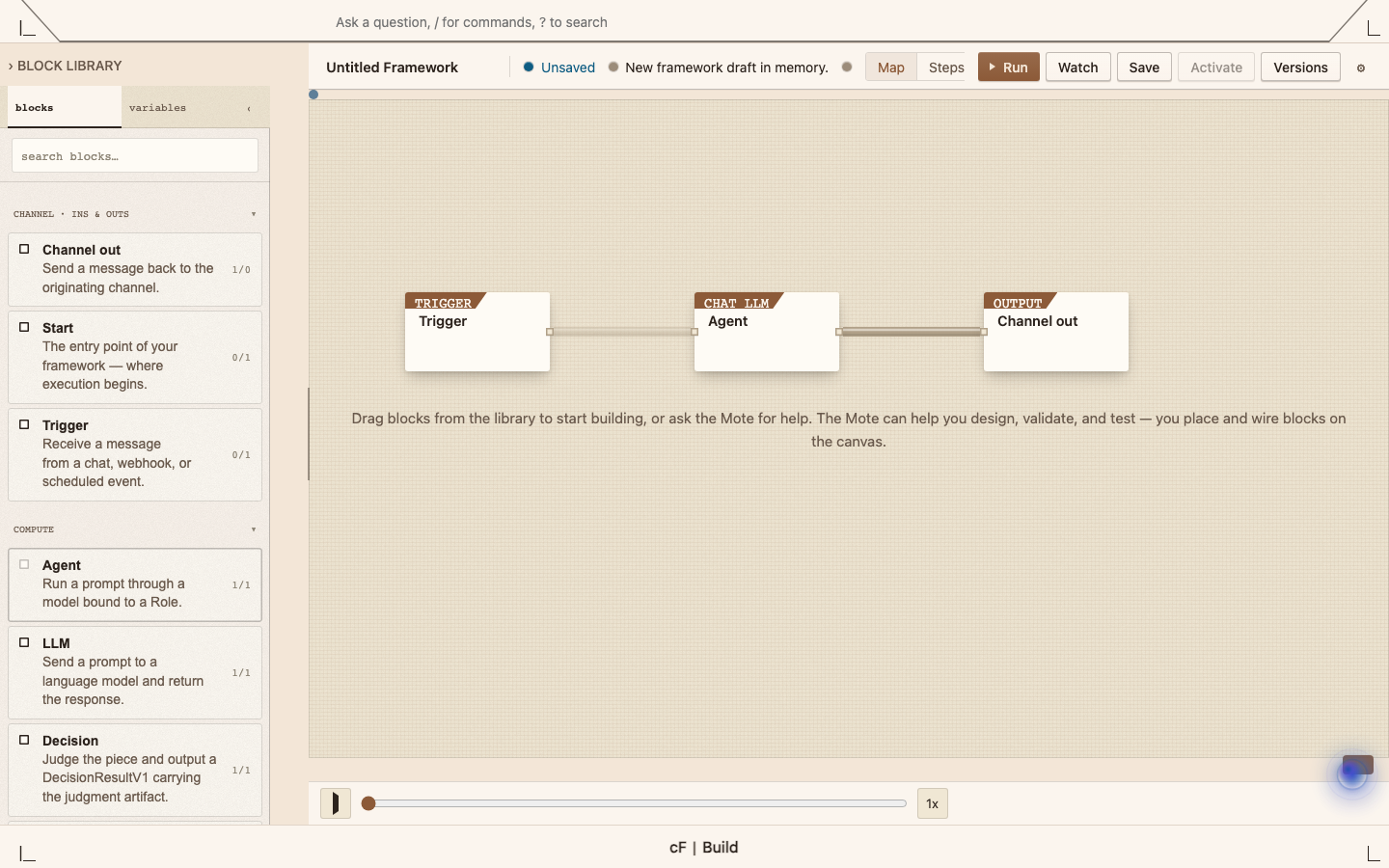
commonFrame is our clearest expression of a clear box: a foundation for applications where people can run work, inspect what happened, revisit an earlier decision, and change what comes next.
Desk brings that foundation to the everyday work of reading, writing, questioning, assessing, and revising. Build connects those activities to the workflows underneath them while keeping the history available to the people who need it.
When we build with commonFrame, the foundations for keeping information secure, managing access, and revisiting earlier work are already part of the design. That gives us more room to concentrate on the application your team actually needs.
Core text kept from the open textbook, with its credit.
Practice questions drafted by Qwen3 4B, then reviewed.
Lab example rewritten around a local creek.
DeviseNina Castillo
AuthorNina Castillo, Qwen3 4B (ai)
ReviewTheo Grant
PrepareNina Castillo
Nina, an instructor, adapted a chapter from an open biology textbook for her course. Qwen3 4B drafted the practice questions. Theo, a librarian, checked that the license and credit carried over correctly.Most work carries the thinking and labor of more people and tools than a byline can hold. DARP is a simple way to record who devised, authored, reviewed, and prepared the work, so credit can travel with it and remain open to conversation.
Our open tools and methods get better when people use them in their own work, ask hard questions, and show us what we missed. In October, we are bringing two of those conversations to open education communities.
We welcome funded research and co-development around attribution, reusable context, assessment, local capability, and access to useful knowledge.
We’ll invite educators to test DARP’s four-stage attribution model against how they create and share work. How does it fit your practice, and where does it fall short?
View the sessionOpenEd26 · Lightning talkAI answers with untested confidence. This lightning talk shares how we challenge AI-assisted work through perspectives built to disagree and round after round of review, with a method you can replicate yourself.
View the sessionBring a question, a hunch, or a rough idea. Share what you’ve tried. We’ll start by listening, then figure it out together.
We take on paid projects, ongoing technical responsibility, funded research, and co-development. Start a conversation below. We reply within two business days, Monday to Friday.